

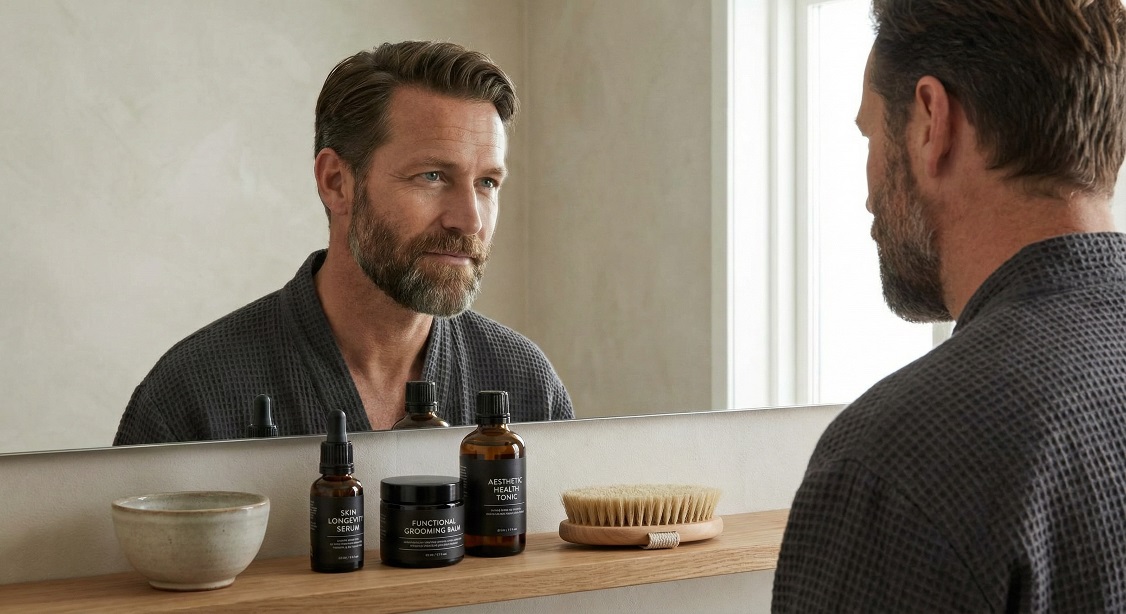
1. Introduction: The Paradigm Shift in Male Aesthetics
The trajectory of the men’s personal care market has undergone a fundamental metamorphosis as we approach the latter half of the 2020s. Historically characterized by a utilitarian focus on hygiene—shaving, cleansing, and basic odor management—the sector has expanded into a sophisticated ecosystem of regenerative medicine, longevity science, and high-performance biotechnology. For the male demographic aged 40 and above (Gen X and older Millennials), this shift is not merely cosmetic; it represents a broader cultural realignment wherein skin health is increasingly viewed as a visible biomarker of systemic vitality, professional competence, and biological resilience.
This report provides an exhaustive analysis of the trends defining the landscape for mature male skincare in 2025 and 2026. It moves beyond superficial product listings to explore the deep psychographic and physiological drivers propelling the market. We are witnessing the death of the “soap and water” era and the birth of “functional minimalism”—a philosophy where time-constrained men demand clinically validated, multi-modal interventions that deliver maximum biological impact with minimal friction.1 This demographic, once hesitant to engage with “beauty” terminology, is now aggressively adopting “longevity tools,” driven by the de-stigmatization of aesthetic procedures and a “biohacking” mindset that seeks to optimize cellular function.2
The analysis draws upon a wide array of clinical data, consumer search behaviors, and industry forecasts to construct a comprehensive view of the “Daddy Do-Over” phenomenon, the rise of “salmon DNA” (PDRN) and exosome therapies, and the integration of systemic health supplements into grooming regimens. It posits that for the 40+ male, the future of skincare is inextricably linked to the science of aging, moving from reaction to regeneration.
2. Psychographics and Consumer Behavior: The Rise of Functional Minimalism
2.1 The “Functional Minimalism” Movement
The dominant behavioral trend shaping the 2025-2026 market for men over 40 is “Functional Minimalism.” Unlike their younger Gen Z counterparts, who may indulge in elaborate, multi-step “Get Ready With Me” routines for social media content, the mature male consumer prioritizes efficiency and efficacy.1 This does not imply a return to simplicity for simplicity’s sake; rather, it indicates a demand for “purpose-driven” formulations that combine multiple mechanisms of action into a single step.
Market intelligence reveals a significant pivot in search terminology. Generic queries for “men’s lotion” are being replaced by highly specific, problem-solution searches such as “men’s oil control moisturizer,” “post-shave repair serum,” and “barrier repair”.1 This linguistic shift demonstrates a deepening of consumer education. The 40+ male is no longer a passive consumer of marketing fluff; he is an informed investigator looking for active ingredients that justify the time and financial investment. The concept of skincare has been reframed as a “daily investment” in personal infrastructure, akin to going to the gym or managing a retirement portfolio.2
2.2 The Professional Imperative and “The Executive Edge”
The motivation for aesthetic maintenance in this demographic is frequently rooted in professional longevity. As the workforce ages and competition from younger digital natives intensifies, men in their 40s and 50s are leveraging aesthetic interventions to maintain a facade of tireless vitality. The desire is to look “rested, confident, and professional” rather than overtly “young” or “enhanced”.4
This “Executive Edge” drives the consumption of fatigue-masking products—cooling mists, caffeine-infused eye rollers, and depuffing serums—as well as more invasive clinical procedures designed to eliminate the “tired” look associated with under-eye bags and drooping eyelids.1 The psychological goal is to project energy and competence, countering the ageist bias often present in corporate environments. Consequently, brands that position their products as tools for “urban defense” and “anti-fatigue” are seeing strong growth.1
2.3 Biohacking: From Silicon Valley to the Bathroom Cabinet
The term “biohacking”—the practice of altering one’s biology to improve performance and health span—has officially entered the mainstream lexicon, named one of the most notable words of 2025 by Collins Dictionary.3 For the male consumer, this cultural wave has merged with skincare. The “biohacker” treats his skin not as a canvas for cosmetics but as an organ system to be optimized.
This mindset facilitates the adoption of advanced “longevity tools” and “interventions.” Men who might scoff at a “beauty mask” are eagerly purchasing “LED photobiomodulation devices” or “microcurrent muscle stimulators” because these technologies align with a gadget-oriented, data-driven worldview.2 This convergence of wellness, technology, and aesthetics is creating a new category of “smart grooming” where devices track hydration levels, UV exposure, and skin barrier integrity, offering a quantified approach to self-care that appeals to the analytical male mind.6
3. The Regenerative Revolution: Topicals and Biotechnology
The most significant evolution in the 2025 skincare market is the transition from “anti-aging” (masking wrinkles) to “regenerative aesthetics” (repairing tissue at the cellular level). This shift is powered by biotechnology, with three key ingredient classes emerging as the gold standard for mature male skin: PDRN, Exosomes, and Ectoine.
3.1 PDRN (Polydeoxyribonucleotide): The “Salmon DNA” Phenomenon
3.1.1 Origins and Mechanism of Action
Polydeoxyribonucleotide (PDRN) has exploded onto the Western market in 2025, following years of clinical success in South Korea. PDRN consists of DNA fragments extracted primarily from the sperm (milt) of salmon trout (Oncorhynchus mykiss) or chum salmon (Oncorhynchus keta). While the biological source may initially seem unconventional to Western sensibilities, the clinical rationale is robust and has overcome initial consumer hesitation.7
PDRN functions as an A2A receptor agonist. When applied to the skin or injected, these DNA fragments bind to adenosine A2A receptors on the surface of cells. This binding event triggers a profound intracellular signaling cascade:
- Anti-Inflammatory Modulation: It reduces the secretion of pro-inflammatory cytokines (such as TNF-α and IL-6) and upregulates anti-inflammatory cytokines (IL-10). For men, whose skin is often in a state of chronic, low-grade inflammation due to daily shaving and UV exposure, this mechanism is critical for reducing redness and sensitivity.9
- The Salvage Pathway: PDRN provides a ready supply of nucleosides and nucleotides. Cells can utilize these raw materials via the “salvage pathway” to synthesize their own DNA during cell division and repair. This is metabolically more efficient than synthesizing DNA de novo, thereby accelerating the rate of tissue regeneration and wound healing.8
- Angiogenesis and VEGF: One of the most compelling benefits for aging skin is PDRN’s ability to stimulate the expression of Vascular Endothelial Growth Factor (VEGF). This promotes angiogenesis—the formation of new capillaries. Improved microcirculation revitalizes the “dull” or “gray” complexion common in men over 40, restoring a healthy, oxygenated glow.9
3.1.2 Clinical vs. Topical Applications
Originally developed for medical applications such as treating diabetic foot ulcers and burns, PDRN has been adapted for aesthetic use in two primary forms:
- Injectables (The “Rejuran” Treatment): In clinical settings, high-concentration PDRN is injected directly into the dermis. This “skin booster” treatment increases skin density and thickness, reversing the thinning that characterizes aging male skin.10
- Topical Serums: For home use, cosmetic-grade PDRN is formulated into essences and serums. Studies indicate that even topical application can improve skin hydration by 45% and accelerate wound healing rates by 40% compared to controls.8 This makes it an ideal ingredient for post-shave products, effectively treating the micro-abrasions caused by razors.11
3.1.3 The “Salmon vs. Plant” Debate and Brand Landscape
As the PDRN trend matures, a sub-trend of “Plant PDRN” (phyto-PDRN) is emerging, marketed towards vegans and those with seafood allergies. Derived from sources like lotus or ginseng, these variants claim similar regenerative benefits, though the bulk of clinical data remains tied to the salmon-derived molecule due to its high biocompatibility with human DNA.10
Leading the market are Korean powerhouses that have cracked the code on stabilizing this molecule. VT Cosmetics with their “PDRN 100 Essence” and “Reedle Shot” technology (which uses microneedle-like spicules to drive ingredients deeper) are category leaders. Anua, Genabelle, and Medicube (with the “PDRN Pink Peptide Serum”) are also dominating the sector.10 Western adoption is following rapidly, with consumers accessing these products via global platforms like Olive Young and YesStyle, while domestic Western brands race to formulate their own versions for 2026 launches.14
3.2 Exosomes: The Cell-Signaling Messengers
3.2.1 The Science of Intercellular Communication
If PDRN is the “building block” of regeneration, exosomes are the “architects.” Exosomes are nano-sized extracellular vesicles (30-150 nm) secreted by stem cells—typically mesenchymal stem cells (MSCs) derived from adipose tissue, umbilical cord, or bone marrow.15 Unlike stem cells, exosomes contain no nucleus or DNA; instead, they are cargo ships carrying a potent payload of mRNA, miRNA, growth factors, and lipids.16
When applied to aging skin cells (senescent fibroblasts), exosomes fuse with the cell membrane and release their cargo. This acts as a paracrine signal, essentially “reprogramming” the older cell to function like a younger one. The result is a surge in collagen and elastin synthesis and a downregulation of inflammatory pathways.15
3.2.2 The Regulatory and Practical Landscape
The use of exosomes represents the frontier of “biotech beauty.” However, the regulatory landscape is complex. In the United States, the FDA has not yet approved exosome products for injectable anti-aging use, classifying them as drug products that require rigorous trials.17 Consequently, the primary compliant application in 2025 is topical application immediately following professional treatments like microneedling or laser resurfacing.18
The micro-channels created by these procedures breach the stratum corneum, allowing the nano-sized exosomes to penetrate deep into the dermis where they can exert their signaling effects. This “Exosome Facial” is becoming a staple in med-spas for men, marketed as a way to slash recovery time (downtime) by half while amplifying results.18 For the 40+ male, who often cites “downtime” as a barrier to procedures, this accelerated healing is a major selling point.
3.3 Ectoine: The Extremophile Barrier Builder
3.3.1 Mechanism: The Hydro-Complex
As men’s skincare focuses increasingly on “barrier health” and “urban defense,” Ectoine has emerged as a critical ingredient. Ectoine is an osmolyte—an amino acid derivative—produced by extremophilic bacteria to survive in lethal environments like salt lakes, deserts, and geysers.20
Its mechanism of action is physical rather than metabolic. Ectoine binds water molecules with high affinity, creating a “hydration shell” or “hydro-complex” around cell membranes and proteins. This structured water layer acts as a physical shield, protecting cellular structures from UV radiation, pollution, extreme temperatures, and chemical irritants.22
3.3.2 Synergy and Sensitivity
For the male consumer, Ectoine solves a critical problem: sensitivity to actives. Men often have compromised barriers due to shaving, making potent anti-aging ingredients like Retinol or Vitamin C stinging or irritating. Ectoine’s powerful soothing and barrier-stabilizing properties allow it to be layered with these harsh actives, mitigating irritation without blocking efficacy.22
This has led to its inclusion in “functional minimalist” formulations—sunscreens that also repair the barrier, and moisturizers that enable the use of retinoids. Brands like Biossance, Dr. Jart+, and niche men’s lines like Anthony and Mythos are incorporating Ectoine to create products that are robust enough for “urban defense” but gentle enough for daily use.25
3.4 Advanced Peptides and “MiniProteins”
3.4.1 Copper Peptides (GHK-Cu)
Copper peptides are experiencing a renaissance in 2025. Unlike exfoliating acids or retinoids that work by irritation/turnover, Copper Peptides work by supporting skin health and structure. They are proven to remove damaged collagen (scar tissue) and stimulate the production of new, healthy collagen, making them exceptional for improving skin firmness and density.28
The trend for 2025 is the “AM/PM Split”: utilizing Copper Peptides in the morning for their antioxidant and structural benefits, and Retinol in the evening for resurfacing. This combination avoids the potential instability of mixing them directly while maximizing the anti-aging “attack” from two different biological angles.29
3.4.2 The “MiniProtein” Breakthrough
A significant technological advancement in 2025 is the development of “MiniProteins™” by brands like Medik8. Historically, large protein molecules (like growth factors) struggled to penetrate the skin barrier due to their size. MiniProteins are engineered to be small enough to penetrate deep into the skin yet retain the complex 3D structure required to bind to cell receptors.30
These molecules are designed to mimic the function of natural growth factors, activating receptors such as TGF-beta to stimulate densification and relax expression lines.30 This represents a move toward “biomimetic” skincare—ingredients that do not just act on the skin, but act like the skin’s own signaling molecules.
4. The Clinical Landscape: The “Daddy Do-Over” and Tweakments
The stigma surrounding male cosmetic procedures has largely evaporated by 2025. Influenced by the “Zoom Boom,” increased social media transparency, and the desire to remain competitive in the workplace, men are embracing clinical interventions. This trend is encapsulated in the “Daddy Do-Over,” a comprehensive suite of surgical and non-surgical procedures designed to address the specific aging patterns of the 40+ male.32
4.1 The “Daddy Do-Over” Surgical Suite
Mirroring the “Mommy Makeover,” the Daddy Do-Over addresses the “dad bod” and facial aging. However, the priorities are distinct:
- Body Contouring: The most common combination involves Liposuction (often high-definition or “etching” lipo) to remove stubborn flank/abdominal fat, combined with Gynecomastia Surgery (male breast reduction). This restores the masculine V-taper that diet and exercise alone often fail to achieve in the 40s due to hormonal shifts.34
- Facial Rejuvenation: The focus is on the eyes and jawline. Blepharoplasty (eyelid surgery) is the second most popular procedure for men, specifically to remove under-eye bags that signal fatigue. This is often paired with Jawline Contouring or neck liposuction to sharpen the profile.5
- The “Hybrid” Approach: A key trend in 2025 is the combination of surgery with non-invasive maintenance. A patient might undergo surgical liposuction but use CoolSculpting or Emsculpt for maintenance and muscle toning, reflecting a long-term strategy rather than a one-off fix.32
4.2 Biostimulators: The Structural Architects
In the realm of injectables, there is a decisive shift away from Hyaluronic Acid (HA) fillers, which can create a “puffy” or “over-filled” look that men particularly dislike. The trend is toward Biostimulators—injectables that trigger the body to grow its own collagen structure.37
- Radiesse (Calcium Hydroxylapatite): Known for its high “G-prime” (lifting capacity/stiffness), Radiesse is the gold standard for male jawline augmentation. It mimics the structure of bone, allowing practitioners to sculpt a sharp, angular jawline that looks entirely natural and masculine.38 Results last 12-18 months, aligning with the male preference for low-maintenance treatments.
- Sculptra (Poly-L-Lactic Acid): Used for global volume replacement, Sculptra is injected deep into the dermis where it acts as a “seed” for new collagen growth. It creates a gradual, subtle improvement over 3-6 months, avoiding the sudden “did you get work done?” questions from colleagues. The cost is significant—averaging $800–$1,200 per vial, with a typical treatment requiring 2-4 vials—but the 2-year duration validates the investment for the mature demographic.39
4.3 Energy-Based Devices (EBDs): Tightening Without the Knife
For men unwilling to undergo surgery, Energy-Based Devices offer a compelling middle ground.
- Morpheus8 (RF Microneedling): This technology dominates the 2025 landscape for skin tightening. By driving gold-plated needles deep into the tissue and releasing Radiofrequency energy, it can remodel fat (subdermal adipose remodeling) and tighten skin simultaneously. It is particularly effective for the “double chin” and jowls.41
- Recovery: The downtime is minimal—typically 1-3 days of redness, often described as a mild sunburn. This fits the “weekend recovery” model essential for professional men.41
- Ultherapy and HIFU: Ultrasound therapies target the SMAS layer (the muscle fascia tightened in facelifts) without breaking the skin surface. This “stealth” rejuvenation appeals to men who require zero visible downtime.43
5. Biohacking and Systemic Health: The “Skin Stack”
The 40+ male consumer increasingly recognizes the “gut-skin axis” and the connection between metabolic health and aesthetic appearance. Skincare is no longer just topical; it is systemic.
5.1 The Longevity Supplement Stack
The “Biohacking” trend has popularized the use of supplements to target the “hallmarks of aging” from the inside out.
- NAD+ Precursors (NMN/NR): Nicotinamide Adenine Dinucleotide (NAD+) levels decline with age, compromising mitochondrial function and DNA repair. Supplementation with precursors like NMN is trending heavily, with early research suggesting benefits for UV resilience, inflammation reduction, and cellular energy.45 While human skin trials are still emerging, the mechanistic logic drives adoption among biohackers.47
- Collagen Peptides: The skepticism around ingestible collagen has waned as hydrolyzed peptides with low molecular weight (2000-3500 Daltons) demonstrate better bioavailability. For men, these supplements are often dual-marketed for joint health and skin elasticity, fitting the “functional” criteria.48
- Senolytics and Anti-Inflammatories: Advanced stacks include compounds like Fisetin and Spermidine (to induce autophagy/cellular cleanup) and Curcumin (liposomal) to combat systemic inflammation (“inflammaging”).50
5.2 Technology and Tools
The integration of technology into the grooming routine is a hallmark of the 2025 landscape.
- LED Light Therapy: Once the domain of spas, high-strength LED masks (particularly Red and Near-Infrared wavelengths) are now common home devices. They target mitochondria to boost ATP production, accelerating repair and reducing inflammation.52
- Microcurrent: Devices that stimulate facial muscles (e.g., NuFace, Foreo Bear) appeal to men as “gym for the face,” offering a mechanical way to maintain muscle tone and lift.52
6. Brand Landscape and Market Dynamics
The market has bifurcated into two distinct winning categories for the male demographic: “Masstige Essentials” and “Clinical Luxury.”
6.1 The Essentials: Masstige Winners
Legacy brands like Dove Men+Care, CeraVe, and Vaseline continue to dominate the volume market by focusing on hydration and barrier repair at accessible price points.53 However, challengers like Harry’s, Dollar Shave Club, and Bulldog have successfully captured the younger Gen X market with cleaner ingredients and better design.
New entrants like Highland (Sustainable/Natural) and Geologie (Personalized regimens) are disrupting the space by offering higher customization.54
6.2 The High-Performance Tier: Clinical and Luxury
For the 40+ man seeking “results,” the shift is toward unisex clinical brands rather than “for men” marketing.
- Western Clinical: Brands like SkinCeuticals, Medik8, and Paula’s Choice are heavily favored because of their ingredient transparency. Men in this demographic read labels; they want to see percentages of Retinol, Vitamin C, and Peptides.30
- Luxury Men’s Specific: Brands like Jack Black and Brickell have successfully bridged the gap, offering high concentrations of actives (like the “Nighttime BAK-up” retinol alternative) in masculine packaging.54
- K-Beauty Infiltration: The “Korean Wave” is undeniable. Brands like VT, Medicube, and Anua are introducing men to concepts like “essences” and “spicules.” The value proposition—extremely high efficacy and innovation at a mid-range price point—is winning over the analytical male consumer.13
7. Strategic Regimens: Protocols for the 40+ Man
Based on the synthesis of 2025 trends, we can construct the “Ideal Protocol” for the 40+ male. This regimen is designed to maximize PDRN and Ectoine usage while integrating biohacking tools.
7.1 The “Functional Minimalist” Morning Routine
Goal: Protection, Barrier Support, and “Executive Presence”
| Step | Category | Key Ingredients | Mechanism & Benefit |
| 1 | Cleanse | Gentle Surfactants | Removal of night oils without stripping lipids. |
| 2 | Active Serum | Vitamin C + Ectoine | Vit C provides antioxidant shield against pollution/UV. Ectoine buffers the acidity, preventing sting and locking in hydration.22 |
| 3 | Structural Support | Copper Peptides | Signals collagen production and firms tissue. Best used in AM to avoid conflict with PM Retinoids.29 |
| 4 | Defense | SPF 50 + Ceramides | Non-negotiable UV protection. Modern formulas include ceramides to repair the shave barrier. |
7.2 The “Regenerative” Evening Routine
Goal: Cellular Turnover, DNA Repair, and Deep Hydration
| Step | Category | Key Ingredients | Mechanism & Benefit |
| 1 | Double Cleanse | Oil Balm -> Foam | Essential to remove water-resistant SPF and urban particulate matter (pollution). |
| 2 | Bio-Signal | PDRN Essence | Applied first (thinnest viscosity). Triggers A2A receptors to initiate repair and calm inflammation.11 |
| 3 | Resurfacing | Retinal/Retinol | Accelerates cell turnover. Applied after PDRN allows the PDRN to act as a soothing buffer, reducing retinoid dermatitis.11 |
| 4 | Occlusion | Lipid-Rich Cream | A heavier moisturizer containing fatty acids and cholesterol to seal the barrier overnight. |
7.3 The “Skin Stack” Add-Ons
- Device Integration: 10 minutes of Red Light Therapy (LED Mask) typically post-cleansing and pre-serum to prime the mitochondria.
- Supplements: Taken with breakfast (NAD+ precursor, Collagen, Omega-3s).
- Professional Cadence:
- Quarterly: Microneedling with Exosomes.
- Yearly: Biostimulator (Sculptra) maintenance for volume/jawline.
8. Conclusion and Future Outlook
The landscape of men’s skincare for the 40+ demographic in 2025 is defined by a convergence of clinical efficacy, technological integration, and systemic health. The era of superficial grooming is over; we have entered the age of “Aesthetic Engineering.”
Key Strategic Takeaways:
- Regeneration is the New Anti-Aging: The terminology and technology have shifted from “fighting” aging to “repairing” it. PDRN and Exosomes are the flagships of this movement, offering a biological narrative that appeals to the male desire for optimization.
- The Destigmatization of Procedures: The “Daddy Do-Over” and the rise of “Tweakments” (Biostimulators, Morpheus8) indicate that men are increasingly comfortable outsourcing their aesthetic maintenance to professionals, provided the results are subtle and the downtime is minimal.
- The Data-Driven Consumer: The 40+ male demands evidence. Brands that succeed in 2026 will be those that provide clear percentages of actives, transparent sourcing (e.g., Salmon vs. Plant PDRN), and clinical validation of their claims.
- The Systemic Approach: Skincare is no longer isolated. It is part of a “longevity stack” that includes diet, supplements, and tech. The successful routine of the future is holistic, treating the skin as the external display of internal health.
As we look toward 2026, the market will likely see further hyper-personalization, with routine customization based on genetic markers and microbiome analysis becoming the new standard for the luxury male consumer. The future is functional, regenerative, and profoundly scientific.